Man, our titles are really going downhill quickly.
As the story goes, Luther, while studying/ teaching at the University of Wittenburg, came across the phrase "
the righteousness of God"(Romans 1:17), and it (as he said) "
filled him with hate." It was after much struggling with the concept of God's righteousness versus our human depravity, that Luther came to interpret the text, and whole argument of Romans, as most evangelicals do today. Namely, that there is no matter of effort that can bring a humanity drowning in its own sin, to a place where it can stand in God's presence. The Apostle Paul goes to great lengths in his letter to the Romans to dissect the problem of man's sin, the human inability to match up, and God's resulting action.
What action? Placing His Son in the very place we should all be.
Let's take it back!
If we recall the covenant between Abraham and Yahweh, we may remember a strange ancient ceremony, in which Abraham and Yahweh (in the form of a pillar of fire) walk through cut up animals. The whole point of that ceremony was to say "May I become like one of these animals, if I do not keep my part of this covenant." What was the covenant? Basically, follow God and things will go well with you. Reject God and things will go badly. Well, we can assume correctly that God keeps his part of the agreement, and correctly that Abraham's descendants do not.
So, now what?
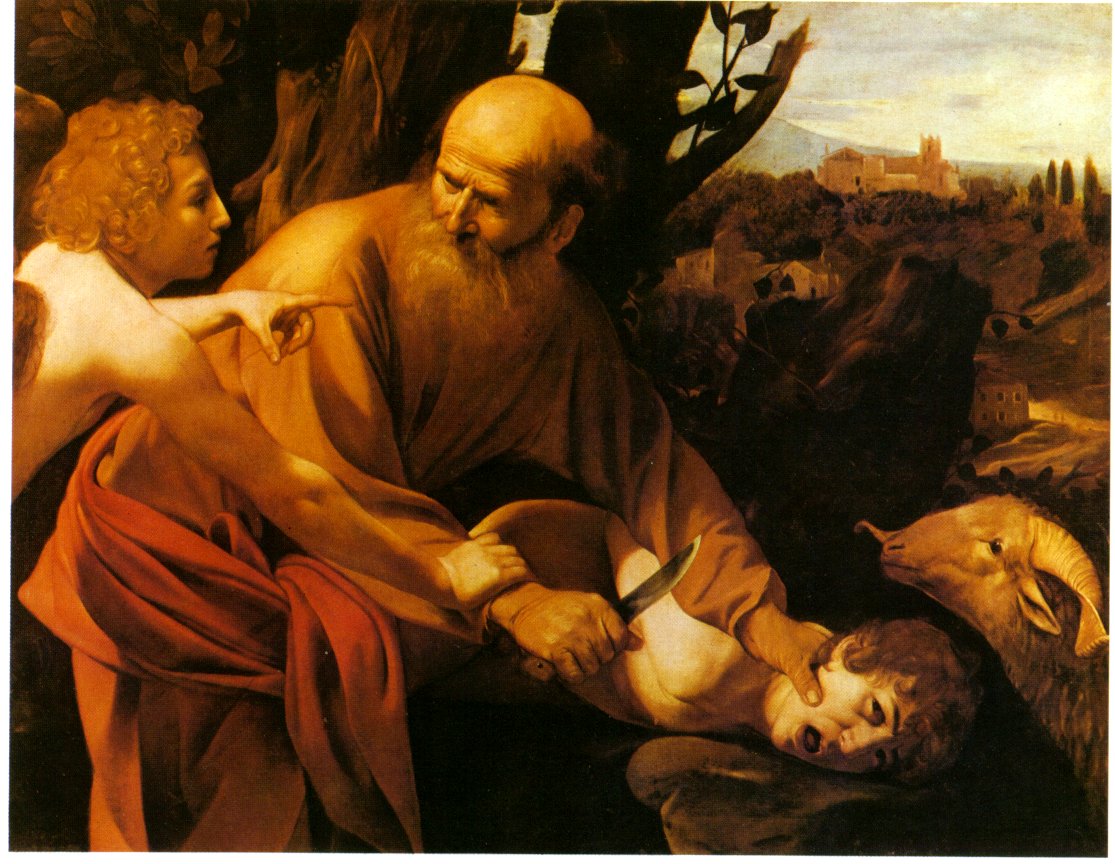
Well, rather than cut up all of humanity (which would kind of step on the whole reason for all of this; namely that God wants to have a relationship with His creation), a sacrificial system is put in place. Priests (representing Israel) place their hands on a ram (signifying the transfer of Israel's sin onto the animal) and the ram is than offered as a sacrifice. At this point every Israelite should have thought to themselves, "That should've been me. I've broken the covenant over and over, in my choices and in my thoughts." But more importantly they are going to throw one of their great parties. Why? Because they are now seen by God, as washed. The blood of the animal has made them clean before their God.
Had they really sinned? Absolutely! Did
they have to pay the immediate price for rejecting God? (of course there were long lasting penalties for sin, but he didn't reach down and squish em' like ants every time they sinned) No way! But they were seen by God as clean.
Now let's jump ahead to the last great Old Testament prophet; St. John the Baptist. His response when he realizes that Jesus is the Messiah is more than just a nice title; it is an announcement.
"Behold the Lamb of God, who takes away the sins of the WORLD." (John 1:29-36) Jesus has now taken on the role as the sacrificial lamb, and not just for the people of Israel, but for the world. Gospel(
good news) indeed!
So, how does this work with the writings of St. Paul, and further how do Paul's writings work with that of St. James.
Paul's letter to the church in Ephesus makes it quite clear that "
it is by grace you have been saved, through faith, and this not from yourselves, it is the gift of God, not by works, so that no one can boast. For we are God's workmanship, created in Christ Jesus to do good works, which God prepared in advance for us to do. "(Ephesians 2:8-10) This passage has a few nuggets we need to explore.
One, the source of man's salvation is God's grace, and the way we attain it is by faith, or belief in it. Second, it is a gift. One does not work for a gift. By definition a gift is simply given. Thus, thirdly, salvation is NOT attained by works. And finally, (and here is where we find Paul actually agreeing with what we will see St. James saying in his letter) we were created (I think we could argue,
recreated) to do good works, which God had planned for us to do.
Thus, Protestants would argue that placing works prior to salvation, places the cart before the horse; works do not gain us salvation, they are a result of it. So, when St. James says, "
that a person is justified by what he does and not by faith alone"(James 2:24), he is not saying that one needs works to be justified, but rather that if one says s/he
is a person of faith, but has
no works, that they cannot be believed.
It is about portraying one's faith. "
Show me your faith without deeds, and I will show you my faith by what I do." (James 2:18b) Having the correct doctrine (
see vs. 19) is not enough. If one has put their faith in Christ, there should be obvious signs. After all, those who have been "
saved through faith...were created in Christ Jesus to do good works." If, therefore, no works are present, one must conclude that that person has not been saved by this grace.